Monday, April 21, 2014

Christ is Risen! A brief commentary on St. Augustine's Sermon 228b

Jan Van Eyck's The Adoration of the Lamb of God
Today I would like to offer a commentary on one of St. Augustine’s sermons purported to have been given during the Resurrection of the Lord perhaps prior to 411 AD. This would have placed the sermon between the first 16 years of his episcopate, and we place this cutoff point because it was at the Council of Carthage in 411 AD that St. Marcellinus (a Roman official) and the Catholic bishops exiled the Donatists from northern Africa and seized their properties, which eliminated much of St. Augustine’s need to address questions of the unity of the Church and Donatism. It is disputed by some scholars that this sermon is a true sermon of St. Augustine, but some (like Edmund Hill OP, whose work I’ve used before) believe it to be a true sermon and so I will proceed anyway in presenting it.

Monday, April 7, 2014

The Self-Effacement of Love, the Impotency of Despair, and Man's Destiny in Eternity

Rose-window of Notre Dame in Paris
This is an ambitious post in that I want to lay the groundwork for some very theoretical and abstract ideas of mine on the meaning of love, the role of despair, and how this reflects the mystery of God. I aim to investigate the image of God from how I have come to understand human love, and hopefully reach upwards to reflect on God’s love for mankind. You must forgive me first for the shallowness of my own soul and the inability with which I am able to comprehend these topics. This post is not so much a form of philosophical proof as an exposition and exploration of opinion, and perhaps in a certain sense persuasion.

God grant me faith. God grant me grace. God grant me hope. God, lay the foundation of my heart in love.

Thursday, March 6, 2014

Judgment, Fraternal Correction, and Modern Lexicon

Icon of St. Paul preaching to the philosophers of Athens
I am coming back to write here at Cor-Inquietum (I know, the misspelling on the URL, it hurts, I know, I know - ) as part of a Lenten resolve to reflect more deeply on the Catholic faith, and life in the light of the Lord, or rather the light of the Lord on life. In this post I would like to briefly consider the modern lexical shift in the philosophy of judgment, from one human being on to another, and then from God’s relationship as Judge to the human soul. I will try and construct my brief meditations from the readings of the Mass for Sunday March 2nd. These were Isaiah 49:14-15; Psalm 62: 2-3, 6-7, 8-9; 1 Corinthians 4:1-5; Matthew 6: 24-34. It is with humility that we must approach the throne of the Lord, though we do so with the renewed confidence that we can boldly approach the Throne of Grace through the mediation of Our Lord Jesus Christ, King of all Creation. Humility because we cannot be presumptuous of God’s mercy as if it were all from our merit, and confidence because it is on account of Christ’s merit and God’s condescending love that we know we are loved unconditionally.

Friday, November 1, 2013

Holy Days of Obligation and Liturgical Realism


O Lord grant me wisdom and Your holy guidance in the path I walk. Grant that I, Your unworthy servant, might speak well on Your behalf. In my speculation and contemplation grant that I might stand by Your side and not be confounded with error.

In this article I would like to speak on the topic of Holy Days of Obligation within the Catholic Church and in separate dioceses of the Catholic Church. What is the rationale behind Holy Days of Obligation besides those which reside on the Lord’s day? How do we move forward in our own lives as we strive to make our entire life a liturgy of praise and worship to God?

Thursday, September 26, 2013

What ought we expect of men considering the priesthood?

La Santa Cena by Juan de Juanes
A friend recently asked me what sorts of qualities I would consider to be valuable in a priest, or what sort of things would lend a man towards becoming a priest, so I thought I might right a post on this topic. Lord, You are a priest forever, according to the order of Melchizedech, grant us wisdom and an increase in vocations to the priesthood. At the outset I said to my friend he ought to be a man, a father, and a follower of Christ. I am inclined to add to my brief comments and of course state that he must be a pastor to the many sheep of the Church, acknowledging that he is also a sheep before God. There is much more to be said of the Catholic priesthood and I only have lightly tread into the deep theology of the Church’s wisdom on the Sacrament of Holy Orders.

It is a fearsome thing to become a priest or feel the desire to become a priest, but for all those who feel God’s call forward to serve them let them not say, “I do not know how to speak. I am too young!” (Jeremiah 1:6), but rather understand with the entire heart to Jesus’ words, “take heart! I have overcome the world." (John 16:33)

Saturday, June 22, 2013

Thoughts on the maxim: Know Thyself


Christ the Light of the World
by William Holman Hunt
I've been on hiatus for quite some time and so I apologize for my long withdrawal from blogging. However, I've come up with a few categories that I’d like to talk about; namely, I have been struggling with a post that hopes to address something I call the poverty of love and more fully the Divine Poverty of Christ (or the Trinity, which is a far higher ideal). This sort of grandiose essay has escaped me for far too long and my love falls far too short to make any honest progress other than what amounts to straw and hot air. In this topic I’d like to just ease back into blogging with the question of whether a man (or woman) ought to strive to know himself very thoroughly or whether it is better to profess a certain form of ignorance surrounding one’s self. Or is there perhaps a dualism by which we ought to know ourselves well in one way but not in another.

Friday, March 22, 2013

"Catch hold of God’s Lowliness", excerpt of St. Augustine's Sermon 117


This excerpt comes from St. Augustine’s Sermon 117, which is an anti-Arian sermon thought to have been written somewhere between 418 and 420 AD. The sermon in its entirety is an attempt to give a sermon on the relation between the Father and the Son so as to show that the Son is both divine and human. St. Augustine strives in the sermon to explain and come to a deeper understanding of what it means for Christ to be human and divine, and what sort of distinctions will be helpful to make in order to further penetrate into this divine mystery. Near the end of the sermon, St. Augustine strives to make clear that humility is the key to entering into God’s mystery, and humility as an entrance into love, which as always is humility to enter into Love Himself.

Lord and Savior of all mankind, come grant us Your Holy Spirit to guide us in the perfection of holy charity.

Friday, March 15, 2013

Reflections on the Prodigal Son


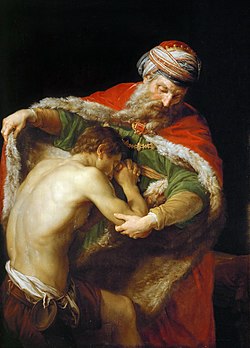
The Return of the Prodigal Son
by Pompeo Batoni
Last Sunday’s Gospel reading in the latin Catholic Church regarded the parable of the prodigal son, a story at face value intended to show the folly of the way of the Pharisees in view of the righteousness of God whose mercy encompasses all of Creation. The reading which I will analyze will be that of Luke 15, verses 11 to 32. My hope is to express perhaps some of the mystery behind God’s righteousness, His mercy, and the divine image which He has placed in each one of us in the spark of human nature and human dignity. Please remember to read the Gospel before my own words!

Most Holy Redeemer guide us!

See here for much better analyses of this story:

A Philosophical Reading of the Prodigal Son (video) [Very thorough and intellectual]

 The Father’s Two Sons: What the Prodigal Son Tells us About Divine Sonship (article) [Brief, brilliant, insightful, and the inspiration behind this post]

Sunday, January 6, 2013

The History of Philosophy on St. Augustine's Confessions


Below is an apt summary of St. Augustine's story in the Confessions provided by Peter Adamson in the website, The History of Philosophy without any Gaps.

http://www.historyofphilosophy.net/augustine-confessions

Saturday, November 24, 2012

Excerpts from St. Augustine’s Propositions on St. Paul’s Epistle to the Romans Part 1


I have not posted on this blog in a very long time and I do not want to leave this blog when I know it spurred me on to lots of interesting quotes from my patron saint, so I’ll try and post a bit now. Albeit you, dear reader, will have to bear smaller posts, since school, career, and health forbid me from writing more than just some tidbits here and there.

Below I’d like to post a few interesting tidbits from St. Augustine’s Propositions on St. Paul’s Epistle to the Romans which was written sometime during 394 AD and so about two or three years before the writing of “Miscellany of Questions in Response to St. Simplicianus”. In this manner, these propositions are a series of notes and writings from his conversations with the other members of the clergy in his vicinity. At this time St. Augustine was a priest for three years, and in the coming year he would succeed Valerius, the bishop in Hippo-Regius, as the bishop of Hippo. This is one of the earliest writings we have in which St. Augustine directly addresses some of the questions in Romans. St. Augustine does address the Law and grace in his earlier anti-Manichean works, but here we see his maturing theology of grace. (I'll write more at another time)

Wednesday, October 17, 2012

Apologies on Late Blog posts

Hello fellow bloggers and internet folks,

I apologize for my lack of blogging in the past month. I have been struggling with many things in my life this past month. I am having some social relationship problems and am struggling with my workload at the time. I ask you for your prayers and your due patience. My apologies to those who have wanted more blogging about St. Augustine in the coming days. I hope I can get at least one post out this month. Blogging will have to be greatly reduced. Please keep me in your prayers, my name is Steven.

May God bless each and every one of you.

Friday, September 7, 2012

Meister Eckhart, Counsel 11 from Counsels on Discernment, what to do when God is far away from us

Image of Master Eckhart
Hello there everybody,

I would like to post a post from Counsel 11 of Eckhart von Hochheim's (Miester [Master] Eckhart) Counsels on Discernment. Eckhart was a Dominican theologian of the 14th century who was brought up on heretical charges by the Franciscan-led Inquisition of the period. Some of his doctrines were regarded as heretical but according to the Catholic Church's decisions in 2010 he was not condemned in name and so may be read as an orthodox theologian, albeit I add, we ought to be cautious.

Thursday, September 6, 2012

Shout out to blog followers

Hi blog followers!

According to my records I've got 3 blog followers and I'd like to make a shout out to you all. Thank you all for supporting my blog and coming to read it from time to time.

I'd just like to write something nice about y'all and perhaps get you all networked too just in case anybody wanted to talk.

Sunday, September 2, 2012

St. Augustine brief quotes on Mary's Dormition and Assumption

Hi there, I'd like to put up two quotes on the Our Lady's Dormition from St. Augustine. I found this from a certain Deacon on Facebook. I'm not sure if he was Catholic or Eastern Orthodox, or otherwise. But here they are!

A sketch of a theological view of the Ave Maria (Hail Mary) prayer

14th century Byzantine Annunciation
 ( Evangelismosicon

This small exposition of mine was drawn up to help me to better reflect on how to teach the Hail Mary prayer, but it got a bit out of hand and there is certainly more content here than just a 4th grade level reflection, which I intended at the outset. All in all, much of my reflection echoes, I think, St. Thomas of Aquinas' reflection on the Hail Mary prayer which did not have the last part of the prayer we know today (Holy Mary, Mother of God, pray for us sinners now and at the hour of our death). You can find his reflection here.

The prayer Hail Mary is a centuries-old and traditional Catholic prayer that in some of its oldest forms is written without the clause, Holy Mary, Mother of God, pray for us sinners now and at the hour of our death. In light of this, we should understand that the prayer itself comes from both the Holy Scriptures and from the light of Catholic Tradition. The full length of the prayer reads:

Hail Mary, full of grace, the Lord is with thee, blessed art thou amongst women, and blessed is the fruit of thy womb, Jesus. Holy Mary, Mother of God, pray for us sinners, now and at the hour of our death. Amen.

Tuesday, August 28, 2012

Augustine: The Decline of the Roman Empire

Hi all you Augustinians out there! I thought I would write a brief post regarding a film that is being pushed around, called "Restless Heart" by Ignatius Press. It's a film about St. Augustine, which was directed by Christian Duguay, a Canadian director, who filmed the television movie, "Augustine: The Decline of the Roman Empire", for Italian television. It was filmed as a two part mini series and has been released with English and Spanish dub. The film was filmed in Tunisia, near Hippo-Regius, or so I read.

It's a great film. And I highly recommend it. It dramatizes some aspects of St. Augustine's life and stays pretty faithful to the autobiographical and historical information that we have, though perhaps there is some element of creativity. I'll try and write a full review of the film as I watch it again through Youtube.

Why did St. Augustine write the Confessions and what does it tell us about him?

The intention of this article herein is to explore St. Augustine's purpose, motive, and desires in writing the thirteen books of his famous Confessions. Why write about his own life, his own sins, his own coming to grace, and what sort of a message is St. Augustine trying to make in his thirteen books? I will strive to explore what the events were in St. Augustine's life that might have spurred him on to write his Confessions, possible motives for why St. Augustine might have written this book, what sort of a book the Confessions is, and what the contents of St. Augustine's Confessions can tell us about him. The other half of this article will discuss another viewpoint on the Confessions and strive to look closely to what place Confessions has in Christian literature and in Christian piety.

What was St. Augustine doing when he was writing his Confessions
I’m writing this article as an exploration of St. Augustine’s possible motives for writing the spiritual classic, The Confessions in Thirteen Books, or more simply the Confessions. Confessions was begun around 397 AD and published near 401 AD, so about one or two years after St. Augustine had become a bishop, taking Valerius’ place as the bishop of Hippo. The article itself will cover what St. Augustine intended when he wrote the Confessions, what it meant in the context of his world and ministry as a bishop, where else we might find a prototype for the kind of work that he completed in the spiritual classic, what the book can teach us about St. Augustine and about the spiritual life, and finally a half of the document will go to answering some negative comments made by an Eastern Orthodox priest regarding St. Augustine's Confessions and its legacy in Western Christendom.

So to begin with I would like to provide more background to St. Augustine's Confessions by noting some of the works that St. Augustine was up to during the period between 397 AD and 401 AD when the work was being written, I will list them below. This list will helps set down what sort of works and interests St. Augustine had in mind before he began writing the Confessions.

Monday, August 27, 2012

First Grade Catechism for Adults 1.01.04: Creation shows God’s love to us

The Andes Mountains

All around us are countless mysteries in the world and many of them can, when we reflect on them in quiet show the beauty and mystery of God. Take for example, water. It’s a simple thing that we have all around us. Here in Chicago we’re blessed with Lake Michigan which provides much of our drinking supply. But liquid water in this solar system is exceedingly rare, and very rare indeed anywhere else in the universe. God has given us a miracle, the miracle of having nearly three quarters of the planet covered in liquid water from which we could live and thrive on. Even more spectacular and unlikely is it how everything in the universe was able to come together to become what it is today so that we could live and come to know God. There ought to be a wonder and awe about us when we consider all that God has made and put before us, even the smallest things like a pebble or an ant crawling on the ground can evoke in us some awe in how small it is and yet how incomprehensible it is to us in its essence. We can see the rock and measure the rock and know many things about the rock but isn’t there something about the rock that stands apart from us, something that perhaps calls us to reflect on the deeper mystery of the rock’s existence. Perhaps this is getting to philosophical, but the point is that God’s creation is full of mystery and we should be full of awe about it.

First Grade Catechism for Adults 1.01.03: God loved me from the foundation of the world

Jesus washing the feet of the Apostles
at the Last Supper.

In St. Paul’s letter to St. Timothy, St. Paul writes that it is pleasing to God that we pray for everybody and that “3[this] is good and pleasing to God our savior, 4 who wills everyone to be saved and to come to knowledge of the truth.” (1 Timothy 2:3-4)1. It is important to know that God loves every single creature that He has created, and He loves men and women, boys and girls, so much that He sent us His only begotten Son into the world to save us from our sins and that whoever lived faithfully by Him would have eternal life2. All of God’s plan for us is sometimes called the history or the plan of salvation. The Lord made us to share in his divine life, that is to be with Him in Heaven and share in the mystery of love between His own self and us. St. Peter in his second letter writes, “Through these, He has bestowed on us the precious and very great promises, so that through them you may come to share in the divine nature, after escaping from the corruption that is in the world because of evil desire.” (2nd Peter 1:4) He writes that God has given us many promises and blessings so as to approach Him and come to even share in God’s mysterious divine nature.

First Grade Catechism for Adults 1.01.02: God made mankind in His image

"The image of the invisible God"
Colossians 1:15
God tells us in Genesis 1:26, “Let Us make human beings in our image, after Our likeness.”1 But we need to ask ourselves what does it mean to be made in the likeness and image of God? Usually when we talk about somebody being the image of somebody else we mean to say that they look like them. For example, a father might tell his wife that their newborn baby boy is the near perfect image of his wife or of himself. However, when we talk about people’s likeness to God we don’t mean to say that in the beginning when God made Adam and Eve that He made them so that they look like what He looks like. This is part of the reason why the Israelites were forbidden from making an image of God, and this is because nobody knew what God looked like, and so God wanted to protect them from confusing Him with images of Him which could never really reflect who He is. Isaiah asks in Isaiah 40: 18-19 who can make an image that looks like God and if anybody could it would not be God, or even look like him. And so we must identify what it means that God made us in His image.